Baptism – 1 Corinthians 10
[Generated Manuscript]
Take a copy of Scripture, if you’d like to follow along, I’ll be reading 1 Corinthians chapter 10, 1 Corinthians 10. Given the joyous activities of this morning and a good refresher that we want to do regularly, I’ll be preaching from this chapter and see just what Paul is talking about with regards to baptism. 1 Corinthians 10, starting at verse 1, I’ll read you verse 13.
Before we hear from the Lord, though, in this passage, let’s ask his blessing upon the reading and the preaching and the perception of that word. Let’s pray. Heavenly Father, we do praise and thank you for your mercy towards us. We pray, Lord, that you at this time arrest our attention and our focus. Lord, drown out all those things of our weak and Lord, and the world and even of our hearts that would seek to harass us and keep us from attending to your word and the teachings that you have therein and the change that you desire to wrought for us through the Holy Spirit. Lord, help us to focus and to hear the voice of our Savior, even in the preaching. Lord, we praise that you have ordained this as a means of grace. Lord, the reading of your word, the corporate participation. even as you have sacraments all girded up, buttressed through prayer.
And so we ask, Lord, meet us according to our needs, according to your plan and your will for our lives. Hear us, Lord, and do just that by your Spirit through this word, we pray. We ask this all in the name of our Savior, Jesus, and all God’s people said, Amen. Amen. 1 Corinthians chapter 1, starting at 1 Corinthians chapter 10, starting at verse 1. Please give your full attention. This is the word of our God.
For I do not want you to be unaware, brothers, that our fathers were all under the cloud and all passed through the sea, and all were baptized into Moses in the cloud and in the sea, and all ate the same spiritual food and drank the same spiritual drink, for they drank from the spiritual rock that followed them, and the rock was Christ’s.
Nevertheless, with most of them God was not pleased, for they were overthrown in the wilderness. Now these things took place as an example for us that we might not desire evil as they did, do not be idolaters as some of them were. As it is written, the people sat down to eat and drink and rose up to play. We must not indulge in sexual immorality as some of them did. And 23,000 fell in a single day. was not put Christ to the test as some of them did, and were destroyed by serpents, nor grumble as some of them did, and were destroyed by the destroyer. Now these things happened to them as an example, but they were written down for our instruction, on whom the ends of the ages have come.
Therefore let anyone who thinks he stands take heed, lest he fall. No temptation has overtaken you. It is not common to man. God is faithful, and he will let you be not let you be tempted beyond your ability, but with the temptation he will also provide a way of escape that you may be able to endure it.
The word of the Lord. Amen. The grass withers and the flowers fall, but this word of our Lord endures truly forever. Well, again, what a wonderful blessing it is that we can, on this Lord’s Day, celebrate both sacraments ordained by the Lord Jesus Christ, baptism and the Lord’s Supper. The Lord has blessed his family, blessed his church with many baptisms over the years. And as I said, there are many more to come in this recent wave of births that we’ve had and this wonderful blessing on his people. And it’s always good in such circumstances, on such occasions, to review Scripture’s teaching on this so crucial subject.
What does God’s Word say about baptism? What does it say? This morning I want to look at this chapter as we have just heard and See what we might learn from it. And we’ll see that the subject is not silent in Scripture. It’s not a topic of indifference or not there. Scripture shows us what God wants us to do regarding baptism. And His Word tells us what? It tells us who are the subjects of baptism, who they are to be, who are to come under the waters of baptism. What does it say? What does God’s Word say about baptism?
It says that the sign… of God has a point, and that the promise of God has the primacy. There is a point in the sign, and God has the primacy of the matter. But the first thing I want us to see is that the people of God have a past. The people of God have a past. God’s people have a common history, a common past in their lives now that they are believers, united to Christ, born into, incorporated into the family of God.
And you’ll notice how this, when you see this, We notice how Paul begins this chapter. He begins the text, I want you to know, brothers, or I do not want you to be unaware, that our forefathers… So you see what Paul’s doing just in this first phrase.
Paul is writing a recall to a church that’s made up almost entirely, if not entirely, of Gentile members. And we know, if you know anything about the Corinthian church, they were a pretty problematic group of people. Plenty of trouble, plenty of issues. going on in the church, hence the letters that we have. Yet Paul is still willing to call them brothers, even though some of the sins that were rampant, they would have made us cringe and wonder if they could even be called a church at all. And yet Paul has no problem at all addressing them throughout this book as brothers to the church in Corinth, saints by calling. And he says to this Gentile church, that’s struggling in its behavior and in its church life.
He says, I don’t want you to be ignorant brothers, he calls them, that our forefathers. Paul’s speaking of the church, to this church that has no Jewish heritage, that has no common history, has no physical or nationally with Israel a common history.
And yet Paul includes this whole church and he says, you brothers share our history because you are now believers in Christ. The history of the Old Testament becomes your history. The history of the people of God throughout history is now your history. And these people back there that we read about are your people. And they have a common faith and a common God with you.
And this is significant because in our day, not new in our day, but certainly the prevailing view today is that the church and Israel are two entirely different things. But when we read the pages of the New Testament… We see that Paul has no problem joining this Gentile church into the story that’s already being told. And he says, we have this mutual ancestry. We have this mutual faith. The Bible makes clear that we, Jew and Gentile, are branches grafted in to that same root. Even in Ephesians chapter 2, it talks about this.
You once who were far off, the far off ones. Far off from the people of God. Far off from the locale of the center of God. All that God is doing. You’ve been brought near. And you’ve not been made to be Jewish people now. You’ve been made into a new man. Jew and Gentile alike created to be one new man, one new people. That is the people of God. People who were named in the name of Christ. Who have been named by the triune God. And that we are being built into one man in Christ.
And it should be clear from the text that there is now this unity between believers in the Old Testament and believers in the New Testament. And they are not separated by some different sort of faith or reality or plan or way. This isn’t the only place that we see this as well. We see this continuity throughout the New Testament. When Paul comes to the core doctrines of the faith in the New Testament, things like justification by faith, when Paul is searching to come up with examples to teach, where does he go?
He points us to Abraham. Remember that? And he says, remember Abraham and what happened to him? He believed God and it was counted to him as righteousness. And Paul’s looking for an example of the blessed man who’s had his sins totally forgiven, who’s been purged utterly of all of his shame. He doesn’t refer to things like the tax collector that was forgiven or Peter and his denial of the Lord at the crucifixion. Instead he goes what? He goes all the way back to the Old Testament and he says in Romans 5, quoting David, he says, remember what David said. Oh, how blessed is the man whose sins are forgiven, whose transgressions are covered. And Paul makes this case from the Old Covenant, the Old Testament, because it is the history of God’s people.
There are no two peoples or two plans. There’s one people and one plan. And this continuity, according to Paul, even flows into the sacraments of the church and baptism and the Lord’s Supper. And we see this in our text. Even this morning, we see that there’s this connection, this mutual history of God’s people in the old and in the new. One people of God, not two.
And what a wonderful truth, right, when we think about this. What a wonderful truth that God calls us and he brings us into his story, this unfolding of history for the redemption of his people of which he has made us a part. Praise him for this, brothers and sisters. Delight in his love, in his inclusion today. that he has given and made of us, and give glory to him, people of God. It is praiseworthy indeed.
So that’s something of the common past of God’s people. And then secondly, we see that God’s sign has a point. So let’s look at what baptism means in the Old Testament according to the teaching of the New and what we can learn from this. And in doing so, we’ll see who are the subjects of baptism as well. Paul’s very clear, very clear about whom he is speaking in chapter 10 of 1 Corinthians here. And he says, all Israel was under the cloud and all passed through the sea and all were baptized into Moses in the cloud and in the sea. Paul says there was a baptism that took place in the Old Testament. And he uses some interesting references. He says the cloud and the sea. When he does this, He teaches us about our present Christian life in telling us this past part of history. And we want to understand what he’s talking about when he does so. What does he mean that they were baptized into the cloud and into the sea?
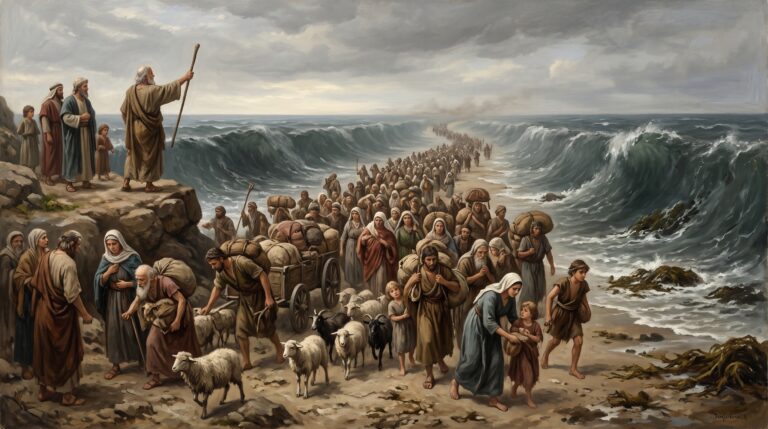
Well, what is the cloud? When we go through the Old Testament, you’ll notice that the cloud has a particular reference to it. The cloud is a sign and a symbol of God’s presence with his people. And so when Israel, for example, is let out in the Exodus, the cloud is there by day and a pillar of fire by night to lead them, to protect them. And it’s God’s way of showing that he is with them. And when the tabernacle is constructed or the temple is built, this cloud comes and it fills the entirety of the temple or the tabernacle in order to show that God’s presence has come. He is there with his people. When the people gather at Sinai, The cloud comes, remember, and it settles on the mountain so that they know that God has arrived. And so when Paul references the cloud, he’s clearly making reference to God’s presence with his people. It’s a specific incident that takes place in the Old Testament that we read about this morning. And recall in Exodus, from Exodus 14, that God’s presence is with Israel in the sign of the cloud.
He’s leading them out. They are in a panic. The Egyptians are behind them. And we see this cloud leading them out and it rises and it goes and then to the back and becomes their rear guard to defend them. And Paul says regarding this cloud that they were under it and that they were baptized into it. Paul calls this movement of the cloud over them, oddly enough to us, perhaps on first reading, calls it a baptism. And then he goes on to say that they were baptized in the sea. Now that may sound strange to us because, you know, it was the Egyptians who were the main ones who were baptized.
They’re the ones that got wet. But he clearly refers to this as a baptism. The sea is referring to the Red Sea, of course, and this is that all-familiar incident to us, of course. It’s well-known. It’s that great redemptive act of the Old Testament. And if you look at what happened leading up to the passage in Exodus 14, we see that God sent… Recall the angel of death on the night of Passover.
And Pharaoh has finally said, after all of it, take your people and get out of here. And the Israelites start their journey. They start in haste towards the promised land. And then they realize that Egypt is now following them. Pharaoh has changed his mind and he wants to come after them and bring back his labor force that he’s just lost and let go.
And remember our Remember our forefathers in the faith, these mighty, courageous, brave men. Remember what their response to Moses was as this happens. Is it because there are no graves in Egypt that you have taken us away to die in the wilderness? What have you done to us in bringing us out of Egypt? Is not this what we said to you in Egypt? Leave us alone that we may serve the Egyptians. For it would have been better for us to serve the Egyptians than to die in the wilderness. Not markers of bravery or courage. Not marks of faith at all. They’re saying, you brought us out here to be murdered by this army, and we clearly can’t fight them. Not the height of faith in Israel.
For sure, they are panicked, and they don’t know what to do. Yet God tells Moses to instruct the people that he’s going to be with them and for them, and that God is going to fight on their behalf. And notice when they come to the Red Sea, right? They don’t say, this is great. It’s a baptism Sunday. This is what we’ve been waiting for. Where we make our great profession of our faith and everyone knows about our commitment to the God of Israel.
That’s not what he does. That’s not what he says. That’s not what they say. What they find when they come to the Red Sea is what? Certain death. Either by the army behind them or they can die trying to get their children and their stuff through the Red Sea that’s in front of them. This is not salvation in their eyes. This doesn’t look like good news and joyous activity for them. This is not the pure waters of baptism that we’re normally used to when we think of such things.
These are people, they are so certain that this will lead to their death that they say it would have been better if we would have just died in Egypt. But God commands and the east wind comes and it begins to separate the waters of and dry land appears, and a whole new nation marches through on dry land. We’ve heard that before. This is recurring. We’ve heard this. Where have we heard this?
Is this the first time a story like this is told to us in Scripture? Where else have we seen these same themes, this same event, these chaotic waters that are commanded to be separated by the presence of wind? What’s the very first pages of the Scriptures?
They say that the earth was formless and void and the spirit was hovering over the surface of the waters. Creation is covered entirely by water and the very spirit of God, the same word that’s used for wind and spirit, Ruach Elohim, the spirit of God is hovering, blowing over the waters and God commands and the waters separate. He separates the waters and finally what appears? It’s dry land.
It’s a place where his people can be established. Where Adam and Eve can live and dwell and live after his commandments and glorify his name. And the same thing is taking place here at the crossing of the Red Sea. The God who commanded light to shine forth from darkness into that darkness. The God who commanded the waters to be separated at creation separates these waters and dry land appears.
And the people walk through ultimately walking forth to a brand new creation. They’re leaving behind the old world they’re coming from. And again, this isn’t the only story in Scripture, the only time, the only accounting in the Bible that has these same elements. Remember as well, I’m sure it’s coming to your mind, the great cataclysmic flood of Noah, the time of Noah, where God undoes all of creation and He recreates.
And like a creation, the world is covered in water. And there’s only one family floating atop of those waters to safety. And what does it take ultimately for dry land to appear in that account? God sends a wind and the waters recede and behold, dry land appears. And Noah and his family walk out onto what is literally a new creation.
It’s a place where they are established. They’re established to walk in God’s ways and to live before him by faith. There’s a connection in Scripture, you see. We see in Peter, 1 Peter 3, 20 and following, it refers to the flood in reference to a baptism. He’s able to look back at the flood and say, that was a baptism. Like Paul looks at the Red Sea and he says also, that’s a baptism. And as these people walk through the waters of the sea, they do so because God sends a wind and dry land is created.
And behold, a new creation is being entered into by a new people. People of God. And notice as Israel passes through these waters, Egypt is left behind. They are renounced. Israel is done with the old way of life. They are being issued forth into a whole new way of life. And God is calling His people now by His name through this action. So notice what’s going on. They renounce that old life. God’s name is placed upon them and they become His people through this action. And they are called from that time forward to what? To live for Him. as a brand new people, called after his name in a new creation. Notice in Exodus 14, before he parts the sea, what is their state?
They have no faith. No faith, which is interesting when we think about it. Prior to their baptism, this called so by Peter, by Paul, they don’t give a grand profession of faith. They have very weak faith, if at all, faith. They say it would have been better for them to have died and forgot to lead them out here to the slaughter. It’s only after the Red Sea crossing, you see, that they turn back and they see the Egyptians floating in the water and they say, now we believe. Notice their faith. When does it come? It comes after baptism.
In Exodus 14, that very account in verse 30. Thus the Lord saved Israel that day from the hand of the Egyptians and And Israel saw the Egyptians dead on the seashore. And Israel saw the great power of the Lord used against the Egyptians, so the people feared the Lord, and they believed in the Lord and in his servant Moses. Notice the timing there. The New Testament clearly calls this action in Exodus a baptism. And so there’s a pattern there, right? God is teaching us in this pattern. God’s people have a past. God’s sign has a point.
And God’s promise has the primacy in all of it. Notice that baptism is not primarily, first and foremost, about our profession of faith. Many times when we look at it, we think that the core of baptism, the very center of it, is our announcing to the world that we are going to follow God. And that the one being baptized is the active party.
I’m sure you’ve heard that. I referenced it earlier. a number of times, and that sentiment is somewhat understandable, right, from our perspective. There is definitely a responsibility to follow God that flows from baptism, even as we heard this morning. But that’s not its essential meaning, right? We can’t put that in the primacy. The primacy is not our profession, in our faith. That’s not what’s happening in baptism. That’s a byproduct of what the Lord is doing, of what baptism is. Instead of being a sign of a profession of faith from the one being baptized, baptism is a sign of what God is doing for his people and a promise of what he will do.
It’s a sign of God’s presence with and for them. It’s God’s way of saying, I am doing something for you. I am opening up a whole new way of life for you. I’m bringing you through these waters and establishing you as a nation. God is the active participant. They don’t even want to be there at this point. And yet after God does these things, there’s the change, right? They begin to change their view of him.
And also notice baptism in this text is a sign of salvation through judgment, right? We have to keep that in mind. These things are called baptisms, the flood of Noah. Clearly, the water there is a judgment water, waters of judgment. God has changed the whole world with salvation here. even as he has judged them. Salvation for God’s people comes through those judgment waters in the flood or in the Red Sea. Notice Israel aren’t the ones under the water, it’s the Egyptians. And those are waters of judgment through which salvation comes for God’s people. So the water is first and foremost a sign of God’s judgment. But thankfully, that judgment is borne out on others and not the recipients who are blessed with the blessings of baptism. And notice, notice who is there in this whole ordeal.
Children are there. Literally children were baptized in this event, according to Paul. There’s no way around that. When the Israelites go from Egypt, they are clearly instructed to take their children with them. Notice what Paul says again. All of Israel was in the cloud and the sea. All of Israel was baptized.
All of them did these things. And so literally, small children, infants, all of them brought through baptism way back then. And we see that there’s this historical community that we’re connected to. And they have a historic baptism that the Bible presents to us in the New Testament, clearly calling it a baptism. And everyone is involved, from the youngest to the oldest.
And we have to ask, as we read this, as we take this in, what are the implications of that baptism? What are the requirements of that baptism? What does it ask of us? What’s required after they are baptized? It’s faith. It’s faith. Faith is required. How do we know this? Look again at the Corinthians. Paul is trying to teach them something. Listen to what he says. Verse 1, do not be unaware. Verse 6, these things took place as examples for us. Verse 11, these things happened to them as an example, but were written down for our instruction. And he uses this illustration from the Old Testament, Israel.
And he says, look, these people had a baptism. They had a meal, spiritual food and spiritual drink. And they drank from the spiritual rock. And the rock that followed them, Christ was the rock. The rock was Christ. And Paul is telling us to look at the similarities here. They were God’s people. They had sacraments like baptism and the Lord’s Supper, right? A sign and a meal. They had Christ with them in the wilderness.
And notice in verse 9, it says, we must not, like they did, put Christ to the test. Another wonderful text of many showing that, yes, indeed, Jesus is in the Old Testament. It is. He was telling the truth when he said, it speaks of me, the law, the prophets, and the writings, all of it.
And Paul says they had all of that, but some of them did not mingle, did not mix all of those benefits with faith in what was the result of They perished in the wilderness. They perished. Paul is definitely giving us a warning here in chapter 10 of 1 Corinthians, and it’s a very stern warning. Beware that you do not do what they did, lest you fall in the wilderness like they did.
So there is this historical community that we are connected to. They had a baptism, and that baptism included the youngest to the oldest people. including their children, even infants, all those in the covenant community, which was required faith after the baptism. And what does that mean for us? We saw in the Old Testament that baptisms refer not to signs of the participant’s faith, first and foremost, and not even signs merely of salvation, but rather they were signs of judgment by water through which salvation comes. They’re redemptive judgments. In each of these examples, both adults and their children were involved in baptism’s watery judgment that led to their salvation and ultimately to a new creation.
Right again, step back and see the pattern that’s being given to us here that we see from the pages of the text of Scripture. And the question is, in regards to that pattern, is that still true in the New Testament and for us? Is that how baptism is spoken of in the New Testament as well? But we look at the imagery that’s used in the New Testament.
In Mark, remember Mark 10, James and John come to Christ and they say, when you come into your kingdom, we want to sit at your right and at your left. And how did Jesus answer them? He says, can you be baptized with the baptism that I’m about to be baptized with? He’s referring there, of course, to what’s coming. It’s his crucifixion. And he looks forward to the cross and he says, there I will be baptized.
Can you do the same thing And it shouldn’t surprise us that the cross is looked at in the Scriptures as a baptism, right? How does that make sense? Why shouldn’t that surprise us? Well, it makes sense if you realize that the flood of Noah and the crossing of the Red Sea, those judgment waters came and destroyed the enemies of God. And that’s exactly, is it not, what is happening on the cross.
God is pouring out His wrath and His judgment on His enemies, and He’s doing so through the crucifixion of His Son. Our sins… Our death, our destruction is being born by this one on the cross as he is baptized with the wrath of God. As God pours out on him all of the fury, all of his just judgment for the sins that we have committed.
And that shouldn’t surprise us. Because when we talk about baptism, those images come to mind in some sense evidently, right? Even if we don’t make those connections, right? When Paul says we are buried with him in baptism, how do you get buried? Usually, right, you die first. And Paul is already making this link there between Christ’s death and our baptism.
And so when we look at that cross, we see that that was the judgment waters of God being poured out upon his son. And it’s a redemptive judgment, praise God. Not just a judgment, full stop. It’s a redemptive judgment for the people of God. And it’s also interesting what happens once these judgment waters are poured out.
If the Old Testament pattern, right, again, think of the pattern. The Old Testament pattern is waters of judgment, God sends wind, then the new creation. Do we see that same thing in the New Testament? Or is that something that’s left behind or radically altered when we come into the new?
Notice that once Christ has died, and once God, by the power of His Holy Spirit, again, wind, Spirit, raises Him from the dead, He comes forth as what, the first man of the new creation. And as Christ ascends, what’s the first thing that takes place as we read the history book of the New Testament, right?
Acts says that suddenly they came from heaven to sound like a mighty rushing wind that filled the entire house where they were sitting. And they began to speak in tongues and fire sits above their heads. And the spirit comes in the form that sounds like rushing wind. And what is the result of that wind? What is the result of that spirit coming down on these people, all speaking in tongues?
Well, we read that 3,000 people are added to the church. Judgment comes, the wind comes, new creation begins. And all of a sudden, those who are lost and dying are being born anew. And by the end of this event, where the mighty rushing wind comes down, the spirit comes down, Peter then, under the inspiration of the Spirit, he decides on that day, at the end of his sermon, to say in Acts chapter 2, the promise of the Holy Spirit has been poured out, that you both see and hear the promises for you and for your children and for all who are far off. Remember who is Paul, who is he talking to? He’s speaking to Jews from every nation under heaven.
Jews that have been raised on the Old Testament, very familiar with the scriptures that they’ve been raised with, they know that the promise to Abraham is just that. I will be a God to you and to your children. Through you, all the nations will be blessed. Jews who know that when God redeemed them from Egypt, their children were part of those promises. Jews who know that on the eighth day, their sons are set apart from the world by receiving the sign of the covenants. And they are circumcised. Jews who teach their children from their very youngest years, you are part of God’s family.
These Jews hear the first sermon of the New Testament church, the new creation church. And at the end of it, Paul says again, the promise is for you and for your children and for the Gentiles. Would they be at all shocked that their children are being included in something that God is doing? Not at all. It would have been completely normal to them to hear this. What are they shocked by? They are shocked that the Gentiles, the far-off ones, get to come in. Not at all that their children get to come in.
Their children have always been part and parcel of their faith. And Peter tells us that that’s going to continue, the same thing. So he quotes from Genesis. And that’s why we see in the rest of the book of Acts, right, that when an individual believes and they have a household, who else is baptized? Everyone in the household. They are being all brought into the visible church and receive the sign of the covenant to which they belong. And that way of faith continues from the Old Testament into the New.
And notice we don’t only see this in the book of Acts. When you get to the epistles, we see this. For instance, in Ephesians. And Paul begins to instruct the church. Remember what he says. The pattern of his teaching as it is such. He gives instructions. the indicatives, then he gives the imperatives, right? He says what is true, and then he says what is due.
And so we have the first three chapters, all these glorious truths of what God has done and who you were and who you are now have been changed, united to Jesus. And he begins to instruct the church in those last three chapters of Ephesians. And he says, listen as I tell you about all the blessings that you have in the heavenly places, right? The first three chapters.
You are seated right now with Christ in heaven. It is God who foreordained all these things before the foundation of the world. He chose you before you were born to be part of God’s family. You who were dead, chapter 2, in your trespasses and sins, you have been made alive together with Christ. And he goes on through all the blessings of salvation.
And then he begins to instruct the church. And he says, husbands, love your wives like Christ loves the church. Wives, submit to your husbands as to Christ. And then he gets to the children. He says, children… Someday in the future when you grow up and reach some mysterious mythical age of accountability and you become Christians, then obey your parents and the Lord for this is right. It’s not what he tells the children. It’s not his word to the covenant children in Ephesians and to all. Notice Paul doesn’t make any differentiation in the congregation between the young and the old. And he even goes on to masters and servants. But Paul in Ephesians, he covers the whole household today.
And he says, all of you have these same promises that come from those first three chapters of the book that I’ve just unfolded for you. All the blessings I’ve told you about in those chapters, I’m speaking to each one of you. And he says, actually what he says to the children is, children, obey your parents.
Notice, in the Lord, for this is right. This is the first commandment with a promise. And he quotes the promise from the Ten Commandments. that was clearly given to Israelite children as well because they’re part of the covenant community. And this does not change as we come into the New Covenant, to the New Testament, as far as how God views our children. And that’s why, brothers and sisters, when we brought these covenant children this morning for baptism, we do so without shame and without apology. We affirm what God has done and what he has said through all of history, that he is a God for us and for our children after us.
And notice these waters are just the beginning of their walk with Christ. These waters will call them to believe in the Lord Jesus Christ day after day and appropriate for themselves the obligations of that covenant. Faith, repentance, life, obedience. These waters will name them even as they name you. These waters that were judgment for Christ, their Savior, will become a sign of their salvation. but they will also be for them a warning, just like we’re seeing here in 1 Corinthians 10. So dear brothers and sisters, you who yourselves have come under the waters of baptism, I’ve said a number of times, Christ has named you with his own name. To you are the promises of God.
And they demand that you repent and believe every day of your life as you look to Christ your Savior again and again and again. Because you will need to again and again and again. And you see, it doesn’t just demand that from the little ones. It demands that from all of us. Which is why, when we pour out the waters of baptism, which, by the way, is why we pour out the waters of baptism, we are required to warn the congregation.
Remember your own baptism by which you were vowed to God. And as you pass through those waters, you renounce the world, the flesh, and the devil. And now God is calling you. He’s saying, I’ve blessed you with myself. Don’t turn back on those blessings. Continue to repent. Continue to believe. You see, this is not some sort of strange magical guarantee.
This is God’s promise and blessing of himself for us. And it requires of us faith in the God who gives the gift. The glorious thing is, it’s the same God who gives the gift of faith. And that requirement is all life long. as we throw ourselves on the work of our Savior, as we rest in His strength, and we rely on His provision, His glorious provision, as we are flailing in the waters of life, and we’ve blown it again and again, we look to Christ, we cling to Him, we cling to His promises for us, and then He will complete the work that He’s begun. He will not forsake us.
Because in those waters of baptism, the very judgment that I deserve and that you deserve were already poured out on Christ. the one who bore those floodwaters and was drowned underneath them so that you and I might be set free. Free not to sin, but free from sin. That we might live before the face of God as the new creations that we now are. If anyone’s in Christ, he’s a new creation.
And if we have failed in those things, and when we fail, as I said, to do so, the glory is. The glory is. And for your children as well. And they need to be reminded again and again that The glory is that we look back and we cling to the promises that God made when he marked us out from the world that we might reaffirm through repentance and faith that Christ is ours and we are his.
You see, baptism shows us that we are God’s all life long, even unto glory. And baptism says to us that God calls us to make every decision for him, for Christ. that we might look all life long to the one who bore our judgment. No judgment remains for you who are in Christ.
And in gratitude, right, we give ourselves to him afresh, again and again and anew. And if we have fallen and as we have fallen, to repent of those things and look to who we are through baptism once again. This water defines you and it tells you who you are even when you don’t feel like it does. His promises, His gift is greater than our feelings and our failures.
Praise God, that is true. So may you remember who you are this day and every day as you look afresh for your salvation, for your very life, to the one who paid that price for you. And may we pray and plead these promises for our children, yes, gloriously, that they all lifelong will believe in the same faithful Savior, who has claimed them in these waters of baptism, as we too remember and rest upon Christ, who is our very life and he himself our very peace. Praise him indeed. What an amazing Savior that we have. Amen. Let’s pray. Our almighty and loving God, we do praise you. We praise you for your work in our lives. We praise you for calling us out of a dead and dying world and giving us life in Christ, eternal life. into home and glory. We ask that you would truly help us anew to believe, believe who we are by virtue of your work in our lives, in calling us and naming us, and that we are truly new creations.
Lord, we are so easy to forget. We are too easy to fall back into the lying thinking that we belong to the world, that we are no good, that you would save the likes of us. Lord, help us Help us to put aside and to put to death those lies that crop up in us again and again from our own hearts and from the world and from the enemy himself.
Help us to remember that you are a God who is our strength and our shield and our weight and our glory. And that you are a God who hears us. And that you are a God who when we fall and fail and we feel broken and in despair, that you as a Father takes our face and lifts us up again and reminds us of the truth. of his love and his power in our lives and sends us away refreshed, rejoicing, reveling in that love. Lord, help us to walk after you with all of our lives.
We pray, Lord, truly, yes, for our dear children, the children of this church, that you would bless them and that they would love you, Lord, with all of their hearts and as they go through this life and as they grow through this life, that they would cling to you More and more and more. As you become more and more aware of your presence in your life and your provision in those promises through your love. And we pray, Lord, for their parents. That they would love their children and truly, yes, rear them according to your will that you’ve given us in your word. And for the husbands and wives, we pray, Lord, grant us to love one another with a Christ-like love, sacrificing a cruciform love to one another. We pray as well, Lord, for those who are on the way or in process in every stage of life.
Even single, Lord, grant them the comfort of your love and the provision in their lives. We do pray for your perfect will for them as well. And that if it is your pleasure, bring others into their lives. Bless them with companionship in relationships that would bring you glory.
But whatever your will, Lord, for them and for all of us, help us to delight in you and to revel in your love and find our satisfaction our true satiation and contentedness ultimately in our Savior, Jesus Christ, who is our all. Help us to have hearts that are full of your love, even as they are, and that we would be attentive to and loving one another in a way that even that itself would be a witness to that world that is dead and dying and desperate, Lord.
They would such need of the gospel. Use us, even in that, Lord. that they would see, they would wonder, what is different about these people? They’re not like the rest of the world. Give us opportunity and give us boldness to tell them the truth of the gospel when we have the opportunity.
Lord, we thank you for your promise to have fed us afresh this day by your word. We thank you for the glorious promises that we’ve seen in the sacrament of baptism and your promise today that you will feed us in this supper with Christ, the bread of heaven. May we see that this is our life and our sustenance through all of this life, even into the new. Lord, we praise you and we thank you that we can come boldly before you. We ask all these things in the name of your Son, our Savior, the Lord Jesus Christ. Amen.